
November 2019

1O give thanks to the Lord, for he is good,
for his steadfast love endures forever.
O give thanks to the God of gods,
for his steadfast love endures forever.
O give thanks to the Lord of lords,
for his steadfast love endures forever;
26 
O give thanks to the God of heaven,
for his steadfast love endures forever.
(Psalm 136:1-3, 26)

Dear brothers & sisters in Christ,

Grace and peace to you from God our Father and Jesus Christ the Lord and Savior. Amen.

God’s steadfast love endures forever. God’s mercy endures forever. God’s lovingkindness endures forever. His faithful love will last forever. God’s love never fails. …his love is eternal. His love endures forever. No matter how you translate it from the Hebrew – God’s love lasts longer than we can imagine. The Psalmist repeats that promise – over and over again. All 26 verses of the Psalm follow the same pattern. Give thanks to the Lord or God did (insert praiseworthy action), his steadfast love endures forever.

The repetition drives home the main point of the Psalm – God’s everlasting love. Traditionally, the verses were/are sung (chanted) in a call and response structure by half verse. A cantor sings the first half of the verse, and the congregation responds with the second half – God’s love endures forever. Thereby obligating the congregation to repeat (26 times) a refrain extolling the eternal nature of divine love. The repetition of the promise commits it to memory.

The Psalmist is using liturgical tradition and ritual to form faith. By continually reciting the truth about God’s love, the people come to believe and trust that truth. Their recitation fortifies their faith.

Even if they manage to forget the rest of the Psalm – the congregation should remember, ‘God’s steadfast love endures forever’ after singing or reciting Psalm 136.

Imagine a Psalm 136. ‘quiz’ (answers in parenthesis).

  • To whom do we give thanks? (God.)
  • What lasts forever? (God’s love and mercy.)
  • How long does God’s love endure? (Forever.)
  • Why do we give God thanks? (His love endures forever.)

It should be fairly easy to ace such a quiz after reciting the Psalm just once. The repetition drills God’s steadfast love into our consciousness – individually and collectively. God’s love for each of you as individuals endures forever. God’s love for you as a community endures forever. Reciting Psalm 136 drills that promise into us.

Many sports or other activities do drills to create ‘muscle memory.’ The goal is to change a desired reaction into a natural reflex. For example, a ball player wants his or her body to automatically react a certain way to match the circumstances. If a fly ball is coming, the mitt goes up not down.

Psalm 136 is a drill to put the promise of God’s steadfast love into our ‘spirit memory.’ Our spirits ‘remember’ “God’s steadfast love endures forever’ even when our minds are not consciously trying to remember. The sentiment that God’s love is eternal is always there within reach. It goes with us and strengthens us when we need it. Like ‘muscle memory’ reflexes, our ‘spirit memory’ reflex pops into action whenever the circumstances dictate its necessity. In the trials and tribulations of our lives (and in all the in-between times) our spirits know – “His steadfast love endures forever.” The promise is sure.

The grace and peace of God which surpasses all understanding keep your hearts and minds in Christ Jesus. Amen.

In Christ,

Pastor Carla
 

August 2019

…because if you confess with your lips that Jesus is Lord and believe in your heart that God raised him from the dead, you will be saved.  (Romans 10:9)

Dear brothers & sisters in Christ,

Grace and peace to you from God our Father and Jesus Christ the Lord and Savior. Amen.

There is an old joke that goes as follows:

Q: “What do you get when you cross a Jehovah’s Witness with a Lutheran?”

A: “Someone who knocks on the door and doesn’t say anything.”

There is an element of truth to that joke – at least the Lutheran part. We have been called ‘shy Lutherans,’ ‘bedroom evangelists’ (evangelism primarily via marriage & procreation), and probably a slew of other catchy phrases that have a similar tone. As a whole, Lutherans are currently known for keeping their faith fairly quiet and private.

Rather ironic considering we were dubbed ‘the Evangelicals’ at the time of the Reformation. This name persists in German speaking countries. Early Reformers, including Martin Luther, were adamant that Christians know what they believe and share that faith in word and deed. In their historical context, baptism had become a method of citizenship. Many ‘Baptized Christians’ had no opportunity to hear the Gospel in a language they understood. Despite being baptized, people had very little awareness of God beyond the tremendous fear instilled by political and ecclesiastical leaders. The acceptable ‘religious edification’ was just enough to terrify so-called believers.

The passage from Romans below took on a different, but just as poignant, urgency. The Romans were afraid to talk about faith; 16th century Europeans had become complacent about it. The end result remained the same: People cannot call on one in whom they do not believe, they cannot believe in one of whom they have not heard, they cannot hear unless someone proclaims, and no one can proclaim unless they are sent. Whether it be out of fear or complacency, the absence of the Gospel remains an absence of the Gospel.

Before the merger of our three predecessor bodies (American Lutheran Church, Evangelical Lutheran Church, & Lutheran Church in America) in the late eighties, careful consideration was given to what this new church body should be called. Attention was given that the components of this new name reflect both the current identity of the predecessor church bodies and the future identity to which God was calling this new church body to cultivate over time. Just as parents try to envision the future of their child when choosing a name, leaders tried to envision the future identity of this fledgling church body. The first, and arguably most important, word of that new name harkened back to our Reformation roots …EVANGELICAL.

Those leaders did not envision a quiet, private church body. They saw God calling this new church body to have an identity steeped in doing mission in the world – a church body living out its calling to be evangelical. Luther certainly did not envision a church body that said nothing. Paul warned several churches about hiding their faith.

Luther’s explanation of the third Article of the Apostles’ Creed (aka Holy Spirit) staunchly asserts this claim, “  I believe that by my own understanding or strength I cannot believe in Jesus Christ my Lord or come to him, but instead the Holy Spirit has called me through the gospel, enlightened me with his gifts, made me holy and kept me in the true faith, just as he calls, gathers, enlightens, and makes holy the whole Christian church on earth and keeps it with Jesus Christ in the one common, true faith.” “Calling, gathering, enlightening, and sanctifying the whole Christian church on earth” is not exactly a discreet task.

The nature of faith is anything but private or quiet. Faith is a gift of the Holy Spirit – the same Spirit that shot out of the sky in flames and wind on Pentecost. It is active, not passive. Faith is vibrant, lively and vigorous. We practice faith. We live by faith. We ‘run the race’ of faith. Faith is not an intellectual endeavor, but our very existence – the reflection of Christ’s being.

“No one after lighting a lamp puts it under the bushel basket, but on the lampstand, and it gives light to all in the house.” (Matthew 5:15) Jesus made this obvious (especially considering lamps at that time had flames and bushel baskets were highly flammable) observation to expose the absurdity of “private or secret faith.” Faith does not lend itself to hiding. The Holy Spirit is not clandestine. The nature of light is to shine. God’s Word is not meant to be silent. The nature of the Word is to be heard.

Although often co-opted by extremists, the actual term ‘evangelical’ is not a naughty word. It literally means, ‘being of the Gospel’ (or ‘being of the good news’). That fits. We are a church body that emphasizes the ‘good news of Jesus Christ.’ We are ‘people of the good news.’ We proclaim Him crucified and risen. His light shines. His Word is proclaimed and heard. We confess that Jesus Christ is Lord.  Our nature is to shine and to proclaim. Therefore, as we are led by the Holy Spirit to roam this earth, we are evangelical.

The grace and peace of God which surpasses all understanding keep your hearts and minds in Christ Jesus. Amen.

In Christ,

Pastor Carla

14 But how are they to call on one in whom they have not believed? And how are they to believe in one of whom they have never heard? And how are they to hear without someone to proclaim him? 15 And how are they to proclaim him unless they are sent?  (Romans 10:14-15a)

May 2019

Let love be genuine; hate what is evil, hold fast to what is good; love one another with mutual affection; outdo one another in showing honor. Do not lag in zeal, be ardent in spirit, serve the Lord. Rejoice in hope, be patient in suffering, persevere in prayer. Contribute to the needs of the saints; extend hospitality to strangers. (Romans 12:9-13)

Dear brothers & sisters in Christ,

Grace and peace to you from God our Father and Jesus Christ the Lord and Savior. Amen.

Like many things in our culture, even prayer can be compartmentalized by people as a ‘specialized’ skill. Even in Jesus’ time, there were folks who thought prayer was ‘best left to the professionals.’ This philosophy has resurfaced again and again throughout the centuries. For whatever reasons, many people can be intimidated by the concept of prayer. People can get caught up in form and forget that prayer is all about the substance – and the Holy Spirit takes care of that.

Prayer can be as natural as breathing. In fact, the Greek (pneuma – pneuma) and Hebrew (רוח- ruach) words used in the Bible for the Holy Spirit are also used for breath. God breathes His Spirit onto the earth. The Holy Spirit is breath and it is by the Holy Spirit that we pray. Our prayers are God’s Spirit flowing within and through us. He Himself nurtures the communication and relationship we have with Him. That Spirit (or breath) is the substance of our prayers. It is as natural as breathing. Just as God breathed life into Adam and Eve, He breathes a Spirit of prayer into us.

Prayer is a precious gift. We have the privilege to communicate directly with God and He has promised to listen. Not only that, He even promises to help us to pray, “Likewise the Spirit helps us in our weakness; for we do not know how to pray as we ought, but that very Spirit intercedes with sighs too deep for words.” (Romans 8:26)

The early disciples had witnessed the power of prayer & heeded His instructions & example to devote themselves to pray. Following Jesus’s ascension, the disciples committed themselves to prayer as they awaited the coming of the Holy Spirit (Acts 1). Throughout the Book of Acts, the followers of Jesus faced each day, mission, dispute, & challenge with prayer.

In the Book of Acts, the only history book of the New Testament, some form of the word ‘pray’ is used 33 times. This is more times than any other book in the New Testament. In fact, the only Book of the Bible to talk more about prayer is the Book of Psalms (many of which are themselves actual prayers).  Prayer was of utmost importance to the earliest Christians. They treasured this gift of the Holy Spirit Jesus had given them. They had the power to converse with God. They had Jesus’ promise that God would listen to their prayers.

To replace Judas, the remaining Disciples prayed in order to choose Matthias. While being stoned, Stephen went as far as to pray for his executors. While in prison, doors were opened for Paul and Silas with prayer. Whenever the early followers of Jesus made any decisions, did any healing, made any travel/mission plans, started any congregation, encountered any conflict or challenge…they prayed. They devoted themselves to prayer and trusted in God’s promise to strengthen, protect, & guide them. They trusted Christ to be faithful as they followed Him.

We too can face each day, mission, dispute, & challenge with prayer – as individuals & as a community. Together we can “persevere in prayer” (Rom. 12:12b) & be “mutually encouraged by each other’s faith”. (Rom. 1:12b) We can devote ourselves to prayer – with God’s Spirit as the respiration of our souls.

Following the example of those earliest disciples, we are renewing our commitment to ‘devote ourselves to prayer’ this Easter season. There are a variety of current prayer ministries below as well as a multitude of other devotional and spiritual practices available. Please prayerfully consider the best way to devote yourself to prayer as we all face the challenges of life and discipleship.

The grace and peace of God which surpasses all understanding keep your hearts and minds in Christ Jesus. Amen.

In Christ,

Pastor Carla

And Jesus came and said to them, “All authority in heaven and on earth has been given to me. Go therefore and make disciples of all nations, baptizing them in the name of the Father and of the Son and of the Holy Spirit, and teaching them to obey everything that I have commanded you. And remember, I am with you always, to the end of the age.” (Matthew 28:18-20)

Parish Prayer Ministries

Prayer Box

  • Each narthex has a ‘Prayer Box’ & accompanying ‘Prayer Request Cards’
  • Cards include a place for request as well as ‘degree of sharing’ boxes. (bulletin/worship, newsletter, prayer chain, pastor only)
  • Boxes will be checked following Sunday worship services & request(s) shared as requested.

Prayer Chain

  • It’s time to revise the Prayer Chain list of participants – notify Pastor by May 19th if interested
  • Participants are asked to keep requests confidential
  • 2 available options to receive prayer requests
    • Phone Chain
    • E-mail Tree

Bulletin/Worship Prayer List

  • Public, urgent/short-term prayer requests

Newsletter Prayer List

  • Public, on-going/long-term prayer requests

Prayer Vigil(s)

  • A 12-hour (8AM-8PM) Prayer Vigil has been scheduled for Ascension Day (5/30/19) @ St Olaf
  • Sign-up sheet for ½-hour slots will be out in May
  • Depending on reception & interest, we may aim for 2 vigils/year


March 2019

Bless the Lord, O my soul,
and all that is within me,
bless his holy name.
Bless the Lord, O my soul,
and do not forget all his benefits—
who forgives all your iniquity,
who heals all your diseases,
who redeems your life from the Pit,
who crowns you with steadfast love and mercy,
who satisfies you with good as long as you live
so that your youth is renewed like the eagle’s.
(Psalm 103:1-5)

Dear brothers & sisters in Christ,

Grace and peace to you from God our Father and Jesus Christ the Lord and Savior. Amen.

God is a god who blesses. God is a god who forgives. God is a god who saves. God is a god who heals. God is active and incarnate. God is present here and now. God has been present in the past and in far away places. God will continue to act in the world and bless His people. As recorded in Revelations, “I (God) am the Alpha and the Omega,” says the Lord God, who is and who was and who is to come, the Almighty.” (Revelations 1:8) That is who God is. He defines Himself with verbs. He makes Himself known by ‘being.’ As He told Moses from the midst of the burning bush, “I am who I am.” (Exodus 3:14) God ‘being who He is’ is a God of action.

During this upcoming season of Lent, we will focus on various ways that God heals. We will focus on the opening verses of Psalm 103 each week – remembering His benefits to us as we bless his holy name.

Oftentimes we have a narrow understanding of healing and limit it to our bodies. God’s healing is broader than our physical ailments. Even mainstream medical science has begun to acknowledge the benefits of holistic healing.

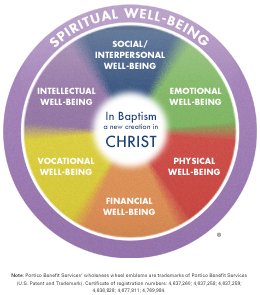
Portico (the benefits & pension department of the ELCA) published a wholeness wheel around the time they switched names. Both were pieces of a vision shift away from crisis management and toward wholeness and prevention.

Portico did not invent this wheel. It is an adaption/compilation of several versions published behavioral science studies. Various recognized experts list anywhere between five and nine areas of wellness or well-being. Portico did put it into a Christian context. At the very center of all wellness is our identity as baptized children of God and surrounding all wellness is our Spiritual well-being.

WholenessWheel_260x295
God blesses us with healing. Yes, sometimes that healing will include the eradication of a physical ailment, but more often it includes so much more than that. God’s healing grants wholeness. Being whole includes every part of us, mind, body, spirit. Notice that the Psalmists lists forgiveness prior to diseases. God heals us of sin. Jesus Himself emphasized a strong correlation between forgiveness and healing. After being criticized for forgiving a man’s sins, Jesus asks the scribes, “Which is easier, to say to the paralytic, ‘Your sins are forgiven,’ or to say, ‘Stand up and take your mat and walk’?” (Mark 2:9)These are not the exact categories we will be exploring this Lent during Midweek services, but this graphic can help you visualize an overall concept of wellness and healing. In addition to our meditation on the opening verses of Psalm 103, our worship will focus on the healings described in the eighth chapter of Luke and the promises recorded to the Romans in the eighth chapter of Paul’s letter to them. These characters are just a snippet of those who have been healed by Christ. They will give us a glimpse at the blessing that wholeness in Christ is.

The hymn, ‘There is a Balm in Gilead’ (negro spiritual) puts a clear Christian spin on the healing God does for His people. “There is a balm in Gilead; To make the wounded whole; There is a balm in Gilead; To heal the sin-sick soul” Again, healing is broader than mere physical restoration. In actuality, this hymn focusses very little on physical healing. It does emphasize the wholeness and strength that come from God, empowering us to follow Christ.

God’s healing comes about when His Son, His faithfulness, His ‘Being’ dwells in us. The final blessing in the 1st Letter to the church in Thessalonica begins, “Now may the God of peace Himself sanctify you completely; and may your whole spirit, soul, and body be preserved blameless at the coming of our Lord Jesus Christ.” (1 Thessalonians 5:23 NKJV) When the very ‘being’ of ‘“I am who I am.” dwells in you, you are made whole, full, complete, well. You are healed.

The blessing in Thessalonians continues, “He who calls you is faithful, who also will do it.” (1 Thessalonians 5:24 NKJV) God does make you whole. Christ does forgive your sins and heal your diseases; Jesus does redeem you from death and crown you with love and mercy. The Lord does strengthen you and make you soar. Be well in Jesus’ name. Be made whole in Jesus’ name. The grace and peace of God which surpasses all understanding keep your hearts and minds in Christ Jesus. Amen.

In Christ,

Pastor Carla

And God, who searches the heart, knows what is the mind of the Spirit, because the Spirit intercedes for the saints according to the will of God. (Romans 8:27)

Love, Love, Love…

Our culture tends to focus more heavily on romance, especially this time of year. Human beings were created to be in relationship with one another. People crave love. God created us to love.

Romance and love have become interchangeable for many people. While our culture may focus heavily on romance, the Bible focusses on love. The love of the Bible is not limited to romance. The love in the Bible describes a myriad of relationships on earth and in heaven.

Some of you may remember a Sunday School song called Love, Love, Love. There are a few different variations of the song out there, but the song begins, “Love, love, love, that’s what it’s all about. God love us, we love each other, mother, father, sister, brother…” Normally geared toward the pre-reading crowd, this song has nothing to do with romance. In fact, 4- and 5-year-olds ‘singing’ “love, love, love” at the top of their little lungs may be adorable, but it is not romantic. It does however proclaim a love that transcends romance.

The love revealed in the incarnation, crucifixion, and resurrection of Christ transcends romance. It is deeper and much more profound than any human gesture. It binds us to Him and one another. The love we have for the Lord and one another is more than an emotional connection. It is founded on a love that surpasses human understanding. It is an extension of God’s love.

Which is more romantic – holding hands across an intimate candlelit dinner or holding hands in a starkly lit oncologist’s office? Which is the more loving? As we journey through our lives, we aim for the more loving acts. God calls us to love Him and to love one another. The grace of God help you reach those heights and depths of true love.

written for the Pastors’ Column & published in St James Plain Dealer, February 14, 2019

Annual Report 2018

From the Pastor

For everything there is a season, and a time for every matter under heaven:

a time to be born, and a time to die;
a time to plant, and a time to pluck up what is planted;
a time to kill, and a time to heal;
a time to break down, and a time to build up;
a time to weep, and a time to laugh;
a time to mourn, and a time to dance;
a time to throw away stones, and a time to gather stones together;
a time to embrace, and a time to refrain from embracing;
a time to seek, and a time to lose;
a time to keep, and a time to throw away;
a time to tear, and a time to sew;
a time to keep silence, and a time to speak;
a time to love, and a time to hate;
a time for war, and a time for peace.
(Ecclesiastes 3:1-8)

Dear brothers and sisters in Christ,

Grace and peace to you from God our Father and the Lord and Savior Jesus Christ. Amen.

Jesus predicted His own death by using agrarian common sense, “Very truly, I tell you, unless a grain of wheat falls into the earth and dies, it remains just a single grain; but if it dies, it bears much fruit.” If the molecular structure of a plant does not develop and change, it remains a seed. If a seed remains a seed, there will be no plants. If there are no plants, there will be no fruit or crop. The very usefulness and worth of that seed lies in its ability to change – it is part of its very nature to change.

As human beings, we do not grow if we cannot adapt and change over time. Our bodies, minds, and spirits require nourishment and their needs change over time. None of us is exactly the same as we were 20 years ago (or longer). We have learned new things. We have seen new things. We have experienced new things. We have grown.

Likewise, the church cannot grow if it remains static. The church cannot live unless it is willing to die. Just as sinners die and are reborn in the image of Christ, so must the church. As the seed must fall into the ground and die in order to bear fruit, so must the church. This means change must and will happen, whether we like it or not.

As Lutherans, we have been taught that we cannot save ourselves. This is a fundamental core tenet of our faith. We are saved by grace through faith. Jesus taught the crowds, “For those who want to save their life will lose it, and those who lose their life for my sake, and for the sake of the gospel, will save it. (Mark 8:35)

This also applies to our congregations and other institutions. The church is dependent upon God’s grace. Just like we undergo a constant flux of death and resurrection in Christ as individuals– so does the church. The experience of death and resurrection is not limited to the individual; it is also communal. The church is also just as apt as any sinner to resist death and resurrection.

Change is difficult, but inevitable. God did not create this world to be static. Life grows, seasons change, water ebbs and flows, even the dirt we walk upon changes. Yet, although it is all around us, the church on earth tends to fear change. For some odd reason, we expect the church not to change while the world around it does.

This is not a new phenomenon. The church on earth has been fighting, fearing, and trying to avoid change since Jesus ascended into heaven. Most, if not all, of the conflict in the Early Church revolved around the fear that accompanied change. The extensive impact of the Reformation was largely a result of avoiding change for centuries. This nation experienced two periods of pervasive renewal termed ‘Great Awakenings’ by church historians. Several new denominations emerged (most split from other denominations) from those ‘Awakenings.’ Churches do not readily embrace change.

Recently I finished a book by Madeline Le’Engle. Toward the conclusion, she warns about the temptation (although penned in the 1970s, but this temptation continues to thrive) to take “shortcuts’ in their attempts to define or discover who they are. She is primarily referring to drugs and sex (common ‘shortcuts’ of that era) and individual self-discovery, but this temptation has manifestations to tempt the church as well.

The church’s ‘shortcuts’ tend to come in programmatic or nostalgic form. The church tends to believe that they can save themselves by either some ‘miracle’ program that someone is doing (& usually selling) or by recreating an idealized past that in reality never existed.

Congregations (and the larger church) tend to resist change until they hit a point of desperation. Actions motivated by desperation tend to be more destructive than constructive. Desperation leads to ‘shortcuts.’ Christ does not call us to act out of desperation. He does not call us to take ‘shortcuts.’ He calls us to act out of faith, love, and hope. He calls us to follow Him.

We do not have a crystal ball to tell us what the future will entail, but two things are most certainly true: 1) the future will not look like the present or the past and 2) God will direct our paths into that future. We journey forward into the future, willing to die, trusting always in God’s promise to raise us up and make a new creation. For everything there is a season…embrace this season and follow the Lord.

The grace and peace of God which surpasses all understanding keep your hearts and minds in Christ Jesus. Amen.

In Christ,

Pastor Carla

For the love of Christ urges us on, because we are convinced that one has died for all; therefore all have died.

 So if anyone is in Christ, there is a new creation: everything old has passed away; see, everything has become new! All this is from God, who reconciled us to himself through Christ, and has given us the ministry of reconciliation;

(2 Corinthians 5:14,17-18)

January 2019

When they saw that the star had stopped, they were overwhelmed with joy. (Matthew 2:10)

Dear brothers & sisters in Christ,
Grace and peace to you from God our Father and Jesus Christ the Lord and Savior. Amen.
This year the day of Epiphany falls on a Sunday. While this does leave us with one less Sunday to sing Christmas carols, it also gives us the opportunity to celebrate the arrival of the magi. (And of course sing ‘We Three Kings’ on the day assigned to celebrate the visitation of those kings)
Epiphany means ‘revelation.’ The significance of the arrival of the magi is that Christ was no longer only revealed to the Jews. God is now revealed to the Gentiles as well! The love of the savior extends outside of the 12 Tribes of Israel. To a nation so intent on ethnocentrism and purity, this was earth-shattering.
It also signifies the recognition of Jesus as king to the outside world. Wise men from far away worship Christ as the King. They rejoice in His light. They see His light. Boundaries between Jew and Gentile were removed. Ethnic boundaries were wiped out. Social and economic boundaries were broken down. This mysterious Christ-child was sought and worshipped by the rich (magi), the poor (shepherds), Jews (shepherds, Anna, Simeon), and Gentiles (magi). The previous boundaries that separated people suddenly were rendered moot. Jesus came to save them all.
It is easy to get caught up in ‘us’ and ‘them’ mentalities. Systems’ theorists use a series of circles to illustrate this idea. Our brains perceive people as being in our inner circle, then in our next circle of intimacy, then another, and another. We mentally organize the people in our lives within these circles depending upon how close we are to them and how we view that relationship. At times, we see those outer circles as threatening. Those people are the ‘thems’ or the outsiders.
The magi existed in the outermost circle of Mary’s and Joseph’s lives. Economically worlds apart, socially worlds apart, ethnically worlds apart, educationally worlds apart, and geographically worlds apart, these people had very little in common with the carpenter from Nazareth and his young wife. By the same token, Mary and Joseph, were far outside the magi’s inner circle. The upper class of the far east did not normally associate with the lower class of an occupied nation. Yet, their commonality was the recognition and revelation of the Christ-child. They were privy to the identity of Jesus. They were recipients of this Epiphany. They saw the Light. The Son of God united them together. This revelation bonded them into One.
Jesus blasts right through the circles. The Light banishes those circles. Those circles only exist in the absence of the Light. They are shadows that tempt us to treat our fellow humans as ‘others’ or somehow ‘less.’ Those circles tempt us to see our brothers and sisters in Christ as ‘them.’ They separate us from God and neighbor, constructing mental, emotional, and spiritual constraints on our faith. There can be no ‘us’ and ‘them’ within true faith. Christ makes us ‘one body.’
As the world throws ‘us’ and ‘them’ designations around like, remember who unites us as one. The Light, Jesus Christ, came into the world to make all people one. He came to tear down the man-made boundaries between us. He came to bring all people into His kingdom. Rely on His faithfulness and obedience to remain in the light. His light has been revealed to you. Walk in the ‘light of life.’ Be filled with great joy. You have seen the light. The light of Christ frees you from your own restraints.
Contemplate John’s testimony and envision the reality he describes: “In the beginning was the Word, and the Word was with God, and the Word was God. He was in the beginning with God. All things came into being through him, and without him not one thing came into being. What has come into being in him was life, and the life was the light of all people. The light shines in the darkness, and the darkness did not overcome it.” (John 1:1-5) The darkness, the shadows, the circles cannot dim the love of God revealed to the world in Christ Jesus. Christ continues to shine in the world, in us, and through us. No matter how impervious the darkness appears, no matter how great our fear of the darkness, no matter how many ‘circles’ we construct to isolate ourselves – the light of Christ shines. The light shines in the darkness, and the darkness did not, does not, and will not overcome it. You have the light of life – walk in it – walk in Christ – and let the light shine.
The grace and peace of God which surpasses all understanding keep your hearts and minds in Christ Jesus. Amen.

In Christ,
Pastor Carla

Again Jesus spoke to them, saying, “I am the light of the world. Whoever follows me will never walk in darkness but will have the light of life.” (John 5:12)

December 2018

A voice cries out:
“In the wilderness prepare the way of the Lord,
make straight in the desert a highway for our God.
(Isaiah 40:3)

Dear brothers & sisters in Christ,
Grace and peace to you from God our Father and Jesus Christ the Lord and Savior. Amen.
We prepare. We wait. We anticipate. God is coming. God is coming soon. Then… God is here.
Sometimes we forget that God is still with us. We conjure an image of the Father sitting far off in heaven with Jesus on a throne beside Him. Who is missing from that image? The Holy Spirit keeps our God in the world. We are blessed to perceive His activities around and among us.
In the Gospel according to Matthew, we hear an angel reassuring Joseph in a dream, “Look, the virgin shall conceive and bear a son, and they shall name him Emmanuel,” which means, “God is with us.” In the angel’s attempt to convince Joseph to not ‘send Mary away quietly,’ we too are reminded of this yet-to-be-born, unconventionally-conceived child’s true identity – Emmanuel, God is with us.
There is something more amazing than Jesus’ conception, more remarkable than Mary’s trek to Bethlehem at 9-month’s pregnant, rarer than a shining star in the sky. It is the amazing truth expressed in that simple name – God is with us. This name, Emmanuel, reveals the nature of God. God is with us.
Probably the most familiar Advent song is ‘O Come, O Come, Emmanuel.’ This hymn has been sung for centuries. Monks chanted the ‘O Antiphons’ as far back as the 8th century and are referenced by church leaders even earlier. These verses, assigned to be sung the final seven days of Advent, emphasize the coming of Christ by highlighting names for the Messiah as foretold by the prophets. These Antiphons became a Latin hymn sung by the laity. Then translated to be sung all over the world. The promise in those words epitomizes the season of Advent and our prayers – O Come, Come Emmanuel – O Come, O Come, God who is with us. Come, Lord Jesus, come!
We are not waiting for a far-off God. We celebrate the arrival of an incarnate God. We celebrate because our God is here – with us – in this place, in this time, in our lives. We celebrate this God whom John described, “And the Word became flesh and lived among us, and we have seen his glory, the glory as of a father’s only son, full of grace and truth.” We are witnesses to this incarnate God entering into our world and into our lives. We are blessed to behold His glory. God chose to reveal His Son to us. God chose to live among us, not away from us.
Sometimes we wonder why the shepherds were frightened by such astounding news. The promised Messiah is here. That’s great, isn’t it? Granted, a whole army of singing angels in the sky may have been a little disconcerting. In addition, the Israelites were convinced that it was fatal to look directly at God. Even their legendary leader Moses, only deigned to view God from the rear as He passed by. For that same God to then ‘take on flesh’ was a terrifying prospect for them. They were accustomed to be afraid of God. This ‘God is with us’ was a foreign concept.
Adding to their fear was most likely the following question, ‘so now what?’. What are the practical consequences of God taking on flesh? What is the impact of an incarnate God? How do we interact with an incarnate God? If God is here with us, life changes. God is with us… now what? What comes next? How does this great news affect me? How will my daily life change?
Many of those same or similar questions most likely plaguing the shepherds assault us as well. How does God being with me change my life? What does it mean for my daily life that God is here? God is not idle, nor is He far-off. God is here. God is with you. What does it mean for the world, the country, the church, the family, to exist in a place where God Himself dwells?
At times this amazing news of God’s incarnation causes us, like the shepherds long ago, to react in fear. As humans who crave control and sometimes even think we can achieve such a goal, God among us frightens us. God among us means we are not in control. We cannot control God and God is here.
Yet, those words of the angel comfort us as well. This is GOOD NEWS – good news of great joy. God is in the world. If God is among us, we are not alone. We can never be alone. He is here. He is with us.
We have a unique God. He is here. He chose to come to us. He chooses to come to you. He chooses to give you life. He chooses to ‘be with’ you. This is ‘good news.’ This is ‘news of great joy.’ Do not be afraid – God is here. Yes, this affects you. Yes, this impacts the world around you. Yes, God is with you.
The grace and peace of God which surpasses all understanding keep your hearts and minds in Christ Jesus. Amen.

In Christ,
Pastor Carla

Then an angel of the Lord stood before them, and the glory of the Lord shone around them, and they were terrified. 10 But the angel said to them, “Do not be afraid; for see—I am bringing you good news of great joy for all the people: to you is born this day in the city of David a Savior, who is the Messiah, the Lord. (Luke 2:9-11)

November 2018

Then he said to me, “It is done! I am the Alpha and the Omega, the beginning and the end. To the thirsty I will give water as a gift from the spring of the water of life. Those who conquer will inherit these things, and I will be their God and they will be my children. (Revelations 21:6-7)

Dear brothers & sisters in Christ,
Grace and peace to you from God our Father and Jesus Christ the Lord and Savior. Amen.
All Saints’ Sunday is a Baptismal celebration, a celebration of the resurrection, as are funerals. In the midst of grief, we commend the faithful departed to the Lord and trust in His promise of eternal life given to each of us in Baptism. On All Saints’ Sunday, we celebrate the communion of saints. Christ has made this promise to each of us and we trust He is faithful.
All Saints’ Sunday is a merger of two Church Feasts: All Saints’ Day and All Souls’ Day. Traditionally, All Saints’ Day is November 1st while All Souls’ Day is November 2nd. The first celebrates and remembers the saints, that is all believers in Christ. The latter commemorates the faithful departed, those who have left this earth in the arms of Jesus. These two are combined into one Sunday festival, celebrating the faithful, living and dead, and their eternal bond in Christ – the communion of saints as confessed in the Apostles’ Creed.
Luther further explains the ‘communion of saints’ and his (or our) own place within that communion.
“…the Holy Spirit has called me through the gospel, enlightened me with his gifts, made me holy and kept me in the true faith, just as he calls, gathers, enlightens, and makes holy the whole Christian church on earth and keeps it with Jesus Christ in the one common, true faith. Daily in this Christian church the Holy Spirit abundantly forgives all sins—mine and those of all believers. On the last day the Holy Spirit will raise me and all the dead and will give to me and all believers in Christ eternal life. (The Small Catechism, The Creed, Article 3: Being Made Holy)”
This year, due to the size of last year’s and this year’s 5th grade classes, we ‘split the difference’ of the calendar (between Maundy Thursday 2018 & 2019) and both classes will celebrate their 1st Holy Communion in their respective congregations on All Saints Sunday. They will experience their first Holy Communion while the church celebrates the communion of saints, emphasizing both the vertical and horizontal ‘communions’ that are experienced within the context of the Lord’s Supper.
The Lord’s Supper is the meal of the faithful – the meal of the saints. Luther describes preparation for Holy Communion as faith.
“…but a person who has faith in these words, “given for you” and “shed for you for the forgiveness of sin,” is really worthy and well prepared… because the words “for you” require truly believing hearts.” (The Small Catechism, The Sacrament of the Altar: Who, then, receives this sacrament worthily?)
This preparation for the sacrament is a work of the Holy Spirit. The Spirit “calls, gathers, enlightens, and makes holy” to empower us to receive the words “for you” with “believing hearts.” The Holy Spirit breaks open our hearts to hear Christ’s promise and trust His promise, making us worthy to participate.
As believers, we each receive the forgiveness of sins thus uniting us to Christ, which in turn unites us to one another. Hence the common title of ‘Holy Communion.’ We experience the sacramental experience of community. In the Lord’s Supper, we are bound to one another in ways that defy our human understanding. We are called into fellowship with the one who saves us.
As we celebrate the saints, we also celebrate our fellowship – our community in Christ. We are connected to one another. We are connected to those who have preceded us in faith. And we are connected to those who have yet come to believe. Christ holds us together and makes us his body in the world. He gave His own body to create this bond. This bond cannot be broken – it is sustained by the power of the Holy Spirit. We gather as His people. We gather as His Body. We gather as His disciples. We gather as brothers and sisters and come to the feast.
The grace and peace of God which surpasses all understanding keep your hearts and minds in Christ Jesus. Amen.

In Christ,
Pastor Carla

God is faithful; by him you were called into the fellowship of his Son, Jesus Christ our Lord. (1 Corinthians 1:9)

October 2018

But how are they to call on one in whom they have not believed? And how are they to believe in one of whom they have never heard? And how are they to hear without someone to proclaim him? And how are they to proclaim him unless they are sent? As it is written, “How beautiful are the feet of those who bring good news!” (Romans 10:14-15)

Dear brothers & sisters in Christ,
Grace and peace to you from God our Father and Jesus Christ the Lord and Savior. Amen.
It is often the most precious treasures that we take for granted. The gift of faith is unparalleled in its value, yet we it is easy to relegate it as an afterthought while giving greater attention to less important aspects of our lives. Faith has often been, in practice at least, deemed an insurance policy. People frequently function as though faith (or God) is available in emergencies but of no use in the meantime. Nothing could be further from the truth. The reality is every single one of us needs God all the time. There is no meantime.
We were created by God to be in relationship with Him and one another. We were made to be connected. Jesus came into this world, lived, died, and rose to facilitate that connection. That connection, that relationship, is True Life. Life is faith. It cannot be set aside or relegated to the bottom of the priority list in life. Without faith, without God, there is no life.
“For by grace you have been saved through faith.” You have been given Life. You have been blessed with the greatest treasure in heaven and earth. God gives you the treasure of faith.
Someone cared enough about you to share with you the Good News of Jesus Christ. God used them to connect to you – to give you faith. Thanks be to God for those beautiful feet that walked into your life. May your feet be beautiful to those around you as you share that precious gift of faith.
The grace and peace of God which surpasses all understanding keep your hearts and minds in Christ Jesus. Amen.

In Christ,
Pastor Carla

For by grace you have been saved through faith, and this is not your own doing; it is the gift of God— not the result of works, so that no one may boast. (Ephesians 2:8-9)